Iowa appeals to people who want space, good schools and a reasonable cost of living. Families moving to the growing Des Moines suburbs, farm families building a new house on the home place, and lake-lovers in northwest Iowa all choose to build here. This guide covers costs, builders, loans, taxes, insurance, and what to know about land and permits.
Why Build a New Home in Iowa
Land is easy to find. Iowa is mostly farmland, so acreages (rural lots of a few acres, often split off from a farm) are a popular choice for people who want room for a shop, a garden or a few animals. Lots in and around small towns are often affordable too.
The climate has four distinct seasons: warm, humid summers and cold, snowy winters. That shapes how homes are built here, with deep foundations, good insulation and efficient heating. The building season is mostly spring through fall, though experienced builders work year-round.
Growth is concentrated in a few areas. Greater Des Moines, including Ankeny, Waukee, Grimes and West Des Moines, has been the fastest-growing part of the state. The Iowa City and Cedar Rapids corridor, the Cedar Valley around Waterloo and Cedar Falls, the Quad Cities, and Council Bluffs near Omaha are also busy. The Iowa Great Lakes around Spirit Lake and Okoboji and Clear Lake in north-central Iowa draw people building lake and second homes.
Types of New Homes in Iowa
Here’s a quick look at the main ways to get a new home in Iowa. For more detail, see our guide to types of new homes.
Custom Homes on Your Own Lot
Building a custom home on land you own gives you the most control over the layout, finishes and where the house sits on the property. It’s a natural fit in Iowa, where acreages and small-town lots are within reach. Many local builders build on lots their clients bring.
Builder and Tract Communities
Production builders put up homes in planned subdivisions, mostly in the Des Moines suburbs, the Iowa City and Cedar Rapids area, and other growing metros. You choose from set floor plans and options. It can be quicker, but you have less say in the lot and design.
Manufactured and Modular Homes
Manufactured homes (built in a factory to a federal code) and modular homes (built in sections to local codes) are both available in Iowa and can lower costs. Check local zoning and lender rules for foundations before buying land for one.
Barndominiums
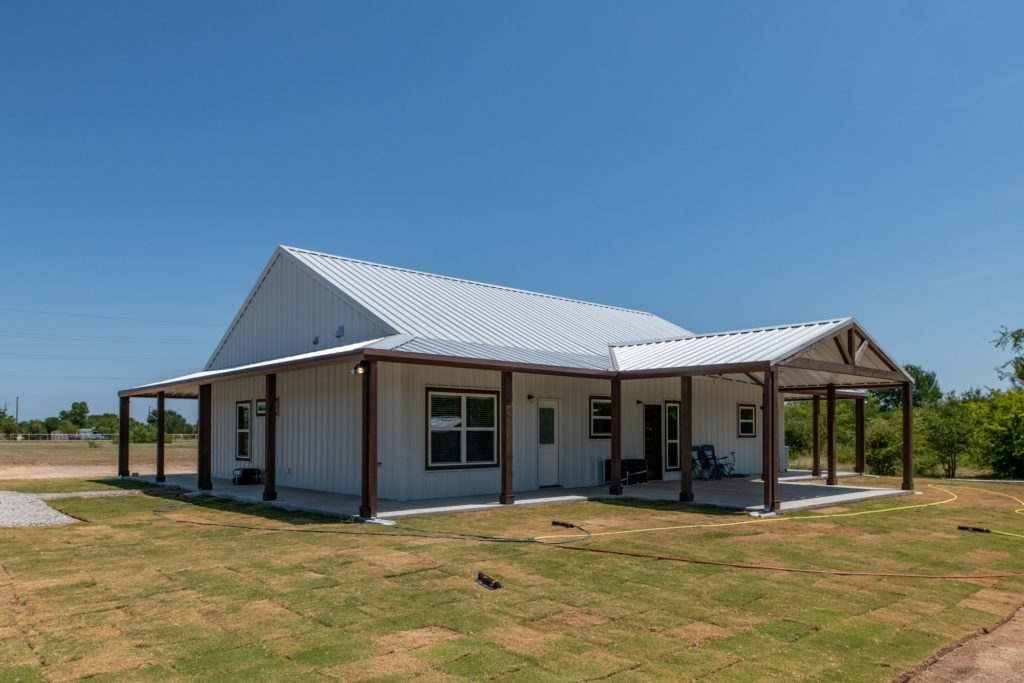
Barndominiums, homes with a barn-style look and often a big shop or garage under the same roof, are popular in rural parts of many states, and Iowa’s acreages are a natural fit. Early versions were metal buildings, but most are now stick-framed (built with wood framing like a regular house), which makes them easier to finance and insure.
How Much Does It Cost to Build a Home in Iowa?
New Home Magazine estimates that building a home in Iowa costs about $165–$255 per square foot for the house itself. For a 2,000-square-foot home, that’s roughly $330,000–$510,000.
Here’s what pushes Iowa costs up or down:
- Frost depth and basements: Footings have to go below the frost line, which is deep in Iowa. Since you’re digging deep anyway, many homes include full basements, which add cost but also add living space and storm shelter.
- Cold-climate features: Extra insulation, high-efficiency furnaces and good windows cost more up front but save on heating.
- Labor market: Builders around Des Moines and Iowa City are busy, and prices tend to be higher there than in rural areas.
- Rural sites: Building far from town can mean longer drives for crews and extra delivery charges.
These numbers are for the house only. Land, site work, wells, septic systems, utility hookups and permits are extra, and on a rural acreage they can add up quickly. To compare with other states, see what it costs to build a new home in all 50 states.
Custom Home Builders in Iowa
Here are some Iowa builders that build custom new homes, from different parts of the state. Always confirm directly that a builder will build on land you own.
- Silent Rivers Design+Build (Des Moines): Designs and builds custom new homes in Des Moines and central Iowa, along with remodeling.
- Jerry’s Homes (Central Iowa and Cedar Rapids): A long-time Iowa builder that offers custom builds as well as move-in-ready homes.
- Fairbanks Builders (Cedar Falls / Cedar Valley): A family-owned builder that designs and builds custom homes with a focus on accessibility.
- Meints Construction Builders (Clear Lake): A locally owned builder that builds new homes and handles remodels in Cerro Gordo County and nearby areas.
- 3D Builders (Spirit Lake): A family-owned design-build firm that creates custom-designed new homes and remodels in the Iowa Great Lakes area.
Iowa requires contractors to register with the state, so ask for a builder’s registration and check it. Get proof of liability and workers’ comp insurance, talk to a few recent clients, and visit a finished home to see the quality for yourself.
Construction Loans in Iowa
A construction loan pays your builder in stages (called “draws”) as work is finished, and you usually pay only interest during the build. A “construction-to-permanent” loan turns into a regular mortgage when the home is done, so you only close once. Learn more in our guide to how construction loans work.
FHA and VA construction-to-permanent loans can lower your down payment if you qualify. USDA rural housing programs are worth a look too, since much of Iowa outside the bigger cities counts as rural.
A couple of lenders to start with:
- Farm Credit Services of America: Serves Iowa, Nebraska, South Dakota and Wyoming and offers rural home loans, including construction loans that convert to permanent financing in one loan package.
- GreenState Credit Union: A credit union serving Iowa, Illinois and Nebraska with a full range of mortgages, including construction draw requests for members who are building.
Local community banks across Iowa also make construction loans, so check with the banks in the area where you’re building.
Property Taxes in Iowa
Iowa’s property taxes are above the national average, though home prices are moderate, so the actual bill on a typical home is often manageable. Taxes are set by your county, city and school district, so they vary a lot by location.
Iowa offers a homestead tax credit for owners who live in the home, and there are extra credits for military veterans and some older homeowners. You apply through your county or city assessor. Keep in mind that your new home will be assessed at its full value once it’s built, so plan your budget around the first full tax bill.
Home Insurance in Iowa
Iowa’s main weather risks are severe thunderstorms, hail, tornadoes and strong straight-line winds (called derechos), plus heavy snow and ice in winter. Flooding is a risk along rivers.
Some practical tips:
- Ask about wind and hail deductibles, which may be a percentage of your home’s value rather than a flat amount.
- Impact-resistant roofing holds up better in hail and may earn a discount.
- A basement or safe room gives you a place to shelter during tornado warnings.
- Standard policies don’t cover flooding. Check FEMA flood maps for your lot and price out flood insurance if you’re near a river or creek.
- Ask about coverage for sump pump backup, which is often an add-on.
- Get a builder’s risk policy while the home is under construction.
See our guide to home insurance for new homes for more.
Buying Land and Getting Permits in Iowa
Cities and many counties in Iowa have zoning, but rules for rural land vary widely from county to county. Some counties have farmland-protection rules that limit splitting off small acreages, while others have little zoning at all. Check with the county before you buy.
Most acreages need a private well and a septic system. Septic permits are handled by your county environmental health office, which will want a soil evaluation before a system can be designed. Do this before you close on the land, because poor soils can raise costs a lot.
Frost depth in Iowa is deep, so footings must go well below ground level. Iowa has a state building code, but cities and counties decide whether to adopt and enforce a building code, so rural areas may have fewer inspections than towns. Ask your county what permits you need. For a full checklist, read how to buy land to build a house.
House Plans for Your Iowa Home
You can browse plans for every style, from ranch homes with walkout basements to two-story farmhouses. If you like the farmhouse or barndominium look, BarndominiumPlans.com has a large collection of barndominium and farmhouse-style plans, and Barndominium Life is a good source of barndominium inspiration.
Final Thoughts
Iowa offers affordable land, plenty of acreage and a strong network of local builders. Plan for deep foundations and storm-ready features, check zoning and septic rules before you buy land, and take your time choosing a builder.