Georgia keeps drawing new residents with jobs in metro Atlanta, a lower cost of living than much of the East Coast, and plenty of land outside the cities. Families build here to get more space, a newer home, and a layout that fits how they live, whether that’s a lake house in North Georgia or a farmhouse on acreage in South Georgia.
Why Build a New Home in Georgia
Land is still relatively easy to find in Georgia, especially once you get outside the Atlanta suburbs. The state runs from the Blue Ridge Mountains in the north, through the rolling Piedmont and farm country in the middle, to the coastal plain and the Golden Isles in the southeast. Lots and acreage in rural counties are often far cheaper than in-town lots near Atlanta.
The climate is mild most of the year, with hot, humid summers and short winters, so building seasons are long. Growth is strongest around metro Atlanta (especially the northern and eastern suburbs), Savannah and the coast, Augusta, Athens, and the Macon and Warner Robins area. Lake communities around Lake Lanier, Lake Oconee, and Lake Hartwell are also popular places to build.
Types of New Homes in Georgia
You have several options when building in Georgia. For a deeper look at each, see our guide to the types of new homes.
Custom Homes on Your Own Lot
Building a custom home on land you already own (or buy separately) gives you full control over the design, the finishes, and where the house sits on the property. In Georgia this is common on rural acreage, lake lots, and mountain property, and many local builders specialize in it.
Builder and Tract Communities
Production builders are most active in metro Atlanta’s outer suburbs, around Savannah and Pooler, in the Augusta area, and in fast-growing towns near Athens and Macon. These homes come with a set menu of floor plans and upgrades and are usually the quickest path to a new house.
Manufactured and Modular Homes
Factory-built homes are a budget-friendly choice, especially on rural land. Modular homes are built to the same state code as site-built houses, while manufactured homes follow a federal code. Check county rules, since some areas restrict where manufactured homes can go.
Barndominiums
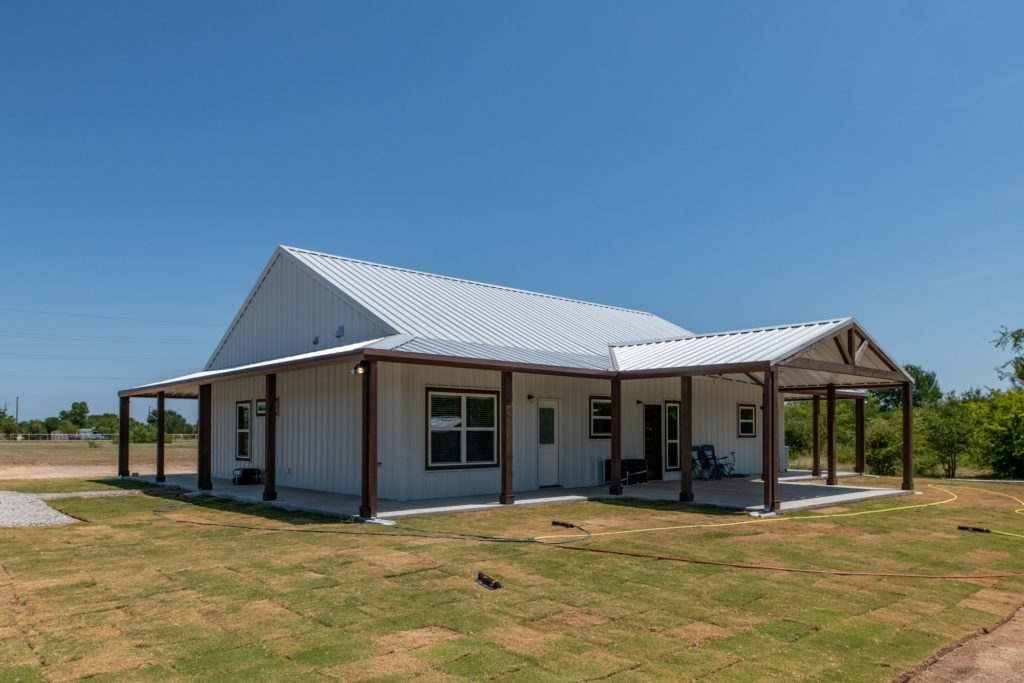
Barndominiums, or barn-style homes with open floor plans and often a shop or garage under the same roof, are popular in rural parts of many states, including Georgia. Most are now stick-framed (built with standard wood framing) rather than steel, which makes them easier to finance, insure, and permit like a regular house.
How Much Does It Cost to Build a Home in Georgia?
New Home Magazine estimates that building a home in Georgia costs about $155–$235 per square foot for the house itself. For a 2,000-square-foot home, that’s roughly $310,000–$470,000.
Georgia’s costs are helped by mild winters and shallow frost depth, which keep foundations simpler. Many homes are built on slabs or crawl spaces rather than full basements, though basements are common on sloped lots in North Georgia. Costs tend to be higher in metro Atlanta, where labor is in demand, and on the coast, where homes may need to meet stronger wind requirements. Mountain lots can add expense for grading, retaining walls, and long driveways.
Remember that the per-square-foot figure covers the house only. Land, site work, a well and septic system if you’re outside city services, and permits are all extra. To see how Georgia compares, check what it costs to build a new home in all 50 states.
Custom Home Builders in Georgia
Here are some Georgia builders that build custom homes, including on land you already own:
- Precision Custom Home Builders (North Georgia): A family-owned custom builder that offers site evaluations and builds on your land.
- Mountain View Home Builders (Gainesville and Northeast Georgia): Builds custom homes in Hall, Habersham, White, Banks, and Rabun counties, including around Lake Lanier and Lake Burton.
- American Craftsman Homes (Forsyth, Middle Georgia): A custom design-build firm focused on high-end homes.
- Capital Home Builders (Thomasville and South Georgia): Builds custom, energy-efficient homes and markets itself as an on-your-lot builder.
- Parr Builders (St. Marys, coastal Georgia): A family business that builds on your homesite anywhere in Camden or Glynn County.
- Schumacher Homes (Northeast and coastal Georgia): A custom builder that builds on the customer’s land, serving Georgia counties near its Franklin, NC and Hilton Head-Savannah design studios.
Georgia requires residential contractors to hold a state license, so check it with the state licensing board before you sign. Also ask for proof of insurance, talk to a few past clients, and tour a finished home to judge quality firsthand.
Construction Loans in Georgia
A construction loan covers the cost of building and pays your builder in stages as work is completed. Many lenders offer a construction-to-permanent loan, which converts to a regular mortgage when the house is done, so you only go through closing once. Read more about how construction loans work.
FHA construction loans allow lower down payments, VA construction loans are available to eligible veterans, and USDA loans can be a good fit in rural Georgia, which covers much of the state outside the big metro areas.
Lenders that make home and construction loans in Georgia include:
- AgSouth Farm Credit: Offers home construction and construction-to-permanent loans and serves counties across Georgia and the Carolinas.
- AgGeorgia Farm Credit: A Farm Credit lender offering home loans for rural Georgia properties.
Local community banks and credit unions are also worth calling, since many handle construction loans in-house.
Property Taxes in Georgia
Georgia’s property taxes are below the national average overall, though rates vary a lot by county and city. Taxes are figured on a portion of your home’s assessed value, and the county assessor will reassess the property once your new home is finished.
Georgia offers a homestead exemption on your primary residence, and many counties add their own larger exemptions or freezes on assessed value. You have to apply with your county tax office, so do it as soon as you move in.
Home Insurance in Georgia
Georgia homeowners deal with a mix of weather risks:
- Severe storms and tornadoes: Spring storms can bring hail, high winds, and tornadoes, especially in central and north Georgia.
- Hurricanes: Coastal counties face hurricane and tropical storm risk, and wind deductibles may apply.
- Flooding: Standard policies don’t cover flood damage. Consider flood insurance, especially near rivers and the coast.
- Termites: Not covered by insurance, but common in Georgia’s warm climate, so ask your builder about pre-treatment.
Shop for coverage before you close on land so you know what to expect. Our guide to home insurance for new homes has more tips.
Buying Land and Getting Permits in Georgia
Georgia has statewide minimum building codes that local governments enforce, based on national model codes. Zoning is handled by counties and cities, and some rural counties have fairly light zoning compared with metro areas, but you’ll still need building permits.
Before you buy land, check:
- Septic: County health departments approve septic systems, usually after a soil evaluation that shows whether the ground can handle wastewater.
- Water: Find out if public water is available or if you’ll need a well.
- Frost depth: Georgia’s frost depth is shallow, which keeps foundation costs down.
- Flood zones and wetlands: Common in South Georgia and along the coast.
- Lake rules: Lots on lakes run by the Army Corps of Engineers or Georgia Power have their own rules for docks and shoreline use.
For a full checklist, see how to buy land to build a house.
House Plans for Your Georgia Home
Southern farmhouses, craftsman bungalows, lake homes with walkout basements, and low-country designs with deep porches all suit Georgia well. You can browse plans for every style before choosing a builder. For barndominium and farmhouse-style designs, visit BarndominiumPlans.com, and for barndo inspiration and real-world examples, see Barndominium Life.
Final Thoughts
Georgia offers a rare mix of affordable land, a long building season, and strong job markets. Line up a licensed builder, get your financing and insurance in place early, and you can build a home that fits your family for decades.