Texas builds more new homes than almost any other state, and it’s easy to see why: lots of land, no state income tax and fast-growing job markets. Many Texans skip the subdivision and build a custom home on a few acres outside the city, from the Hill Country to the Piney Woods.
Why Build a New Home in Texas
Texas has more open land than nearly any other state, and rural acreage is still within reach for many buyers, especially once you get outside the big metros. You can find everything from small lots near town to large ranch parcels.
The climate varies a lot across the state. Most of Texas has hot summers and mild winters, but the Panhandle gets real cold and snow, the Gulf Coast is humid and exposed to hurricanes, and West Texas is dry desert. Severe storms, hail and tornadoes are common in North and Central Texas in the spring.
Growth is strongest around Dallas-Fort Worth, Houston, Austin and San Antonio, and in the towns along the I-35 corridor between Austin and San Antonio. The Texas Hill Country and the counties surrounding the big metros are especially popular with people building on acreage.
Types of New Homes in Texas
Texas buyers have all the main types of new homes to choose from.
Custom homes on your own lot. This is a big part of the Texas market, especially for people with rural land. Several Texas builders specialize in building on your land, and you can pick a plan and finishes that fit your site and your budget.
Builder communities. Master-planned communities are everywhere around Dallas-Fort Worth, Houston, Austin and San Antonio. They’re quick and often affordable, with amenities like pools and trails, but you choose from a set list of plans.
Manufactured and modular homes. Factory-built homes are very common in rural Texas because they’re affordable and go up quickly. Check deed restrictions, since some rural subdivisions don’t allow them.
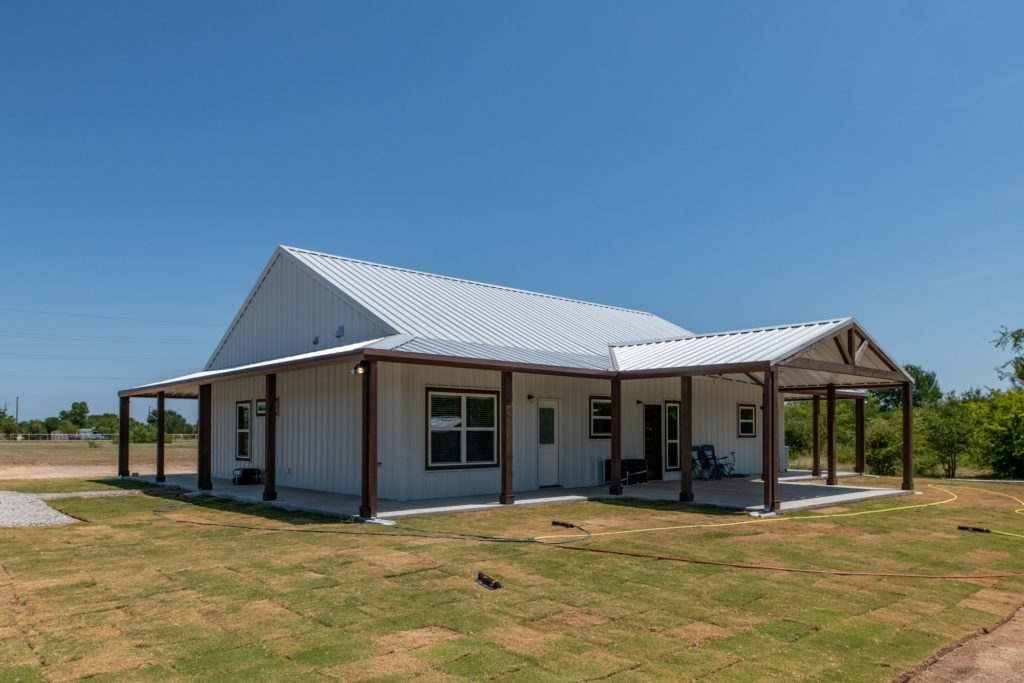
Barndominiums. Barndominiums, homes with a barn-style shell and open living space, are popular in rural parts of many states, and Texas is one of the places that made them famous. Most are now stick-framed (built with wood framing like a regular house) rather than all steel, which makes them easier to finance and insure.
How Much Does It Cost to Build a Home in Texas?
New Home Magazine estimates that building a home in Texas costs about $145–$220 per square foot for the house itself. For a 2,000-square-foot home, that’s roughly $290,000–$440,000.
Texas is one of the more affordable states to build in, thanks to a large labor force and mostly slab foundations, which are cheaper than basements. Costs go up along the Gulf Coast, where homes need to meet windstorm (hurricane) building standards, and in areas with expansive clay soils, which require engineered foundations to prevent cracking. Austin and parts of Dallas-Fort Worth have higher labor and permit costs, and remote ranch sites cost more to reach.
These numbers cover the house only. Land, site work, a well and septic system, utility connections (which can be expensive on large rural tracts) and permits are extra. For a state-by-state comparison, see what it costs to build a new home in all 50 states.
Custom Home Builders in Texas
Here are some Texas builders that build custom homes, including several that focus on building on your land:
- Tilson Homes (Austin, San Antonio, Houston, Waco, Dallas-Fort Worth and rural Texas): A build-on-your-lot builder that builds new homes on customers’ land across much of the state.
- Kurk Homes (Texas Hill Country and Greater Houston): Builds custom homes on your land and offers site cost evaluations before you build.
- Couto Homes (Fort Worth and surrounding DFW): A luxury custom home builder that builds on your own land or in its communities.
- Kindred Homes (Dallas-Fort Worth): Offers a build-on-your-lot program along with homes in its own neighborhoods.
- CMW General Contractors (Texas Hill Country): A family-owned contractor that builds custom homes and barndominiums and handles remodels.
Texas doesn’t license general home builders at the state level, so it’s up to you to vet them carefully. Ask for proof of insurance, check reviews and complaints, call several past clients, and walk through a home the builder recently finished. Make sure any plumbers and electricians on the job are state-licensed, since those trades do require a license in Texas.
Construction Loans in Texas
A construction loan pays for building your home in stages (called draws) as each phase is completed. You usually pay interest only during the build. A one-time-close loan combines the construction loan and the permanent mortgage into one, so you only close once. See how construction loans work.
FHA and VA loans can be used for new construction through lenders that offer them, which is helpful for the many veterans in Texas. USDA loans are a strong option in rural Texas, which includes large parts of the state outside the major metros, if your income qualifies.
Lenders to look at:
- Capital Farm Credit: A Texas Farm Credit lender with homesite loans and one-time-close construction loans for rural homes.
- AgTrust Farm Credit: A Texas Farm Credit lender (the old Lone Star Ag Credit website now points here) that finances rural land, home construction and the long-term mortgage, for home sites as small as one acre.
Property Taxes in Texas
Texas has no state income tax, but its property taxes are among the highest in the country. Taxes are set by counties, cities, school districts and special districts such as MUDs (municipal utility districts that pay for water and sewer in new developments), so bills can vary a lot even between nearby neighborhoods.
Texas offers a homestead exemption on your primary home that lowers the taxable value for school taxes, plus extra exemptions for seniors, people with disabilities and disabled veterans. A homestead also limits how much your home’s taxable value can rise from year to year. File for it with your county appraisal district once you move in. If you own rural land used for farming or ranching, ask about an agricultural valuation, which can lower the taxes on the land (not the house).
Home Insurance in Texas
Texas faces almost every kind of weather risk. Hail and tornadoes are common in North and Central Texas, hurricanes and flooding threaten the Gulf Coast, wildfires affect West and Central Texas, and the 2021 winter storm showed that freezes can cause serious pipe damage even in the south. Home insurance premiums in Texas are among the highest in the country.
Practical tips: choose an impact-resistant roof to help with hail (and possibly lower premiums), build to windstorm standards on the coast, buy separate flood insurance even if you’re not in a mapped flood zone, and insulate pipes. Coastal homes may need wind coverage through the Texas Windstorm Insurance Association. See home insurance for new homes.
Buying Land and Getting Permits in Texas
Cities in Texas have zoning and building codes, but counties have very limited power to regulate land use. That means much of rural Texas has no zoning and often no building permits or inspections outside city limits. Many rural subdivisions have deed restrictions instead, which can limit things like home size, manufactured homes or livestock, so read them carefully before you buy.
Even where there are no county building inspections, you’ll still need a permit for a septic system (called an on-site sewage facility, or OSSF) from the county or the state environmental agency, and a site evaluation before the system is designed. You’ll also need to check water: some areas rely on wells, and some groundwater districts regulate new wells. Expansive clay soils are common, so get a soils report and an engineered foundation design.
Frost depth is shallow in most of Texas but deeper in the Panhandle. For more, see how to buy land to build a house.
House Plans for Your Texas Home
Ranch homes, modern farmhouses, Hill Country stone homes and barndominiums with big shops are all popular in Texas. Deep porches, metal roofs and good shading help with the heat. You can browse plans for every style. For barndominium and farmhouse-style plans, visit BarndominiumPlans.com, and for barndominium inspiration, take a look at Barndominium Life.
Final Thoughts
Texas makes it easier and more affordable to build than most states, but property taxes and insurance can be high, so build them into your budget from the start. Read the deed restrictions, check septic and water before you buy, and take time to vet your builder.